


 Union zur Förderung von Oel- und Proteinpflanzen E.V.
Diesel standard limits the use of biodiesel
UFOP: Maximising the potential of biodiesel in blends and as a pure fuel
Berlin, 16 September 2026. Whilst the share of biodiesel in the diesel market remained stable in the first half of 2026, imported HVO recorded strong growth; the volume rose from 68,500 tonnes in the same period of the previous year to 337,100 tonnes. According to the Federal Office for Economic Affairs and Export Control (BAFA), biodiesel sales, at 1.062 million tonnes, remained almost at the previous year’s level (1.085 million tonnes). In view of the critical supply situation for diesel fuel, the Union for the Promotion of Oil and Protein Crops (UFOP) is calling for the full utilisation of blending potential and the use of biodiesel as a pure fuel.
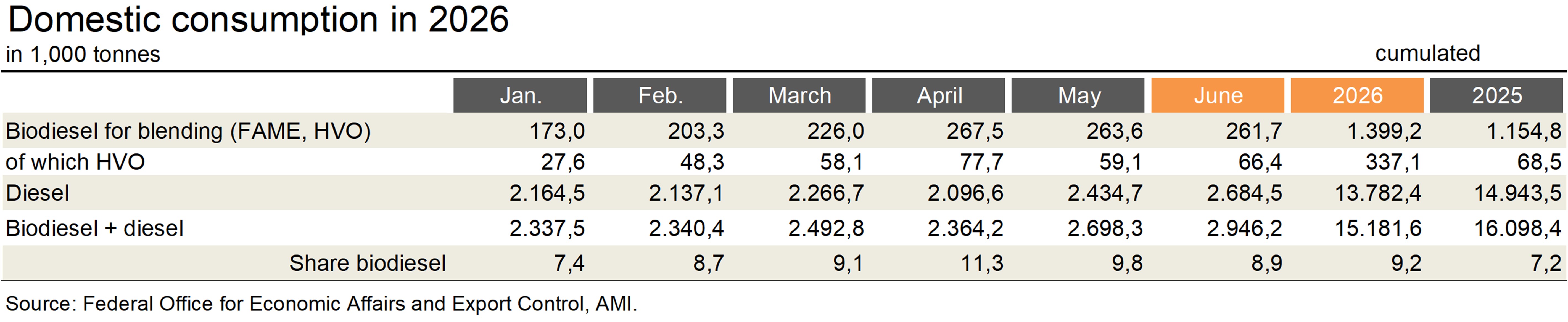
The UFOP notes that the maximum blending limit of 7 per cent by volume, as specified in the DIN EN 590 diesel fuel standard, governs the use of biodiesel not only in Germany but across the EU as a whole. Consequently, the use of B30 in dedicated fleets for heavy goods transport and of B100 are key options not only for consolidating biodiesel sales but, in view of the transport sector’s climate protection obligations, are also a matter of urgency. Given the supply bottlenecks in crude oil and diesel caused by the Middle East conflict and Russia’s war against Ukraine, B100 is also becoming increasingly relevant in terms of security of supply. Germany, in particular, is reliant on diesel imports. At the same time, electrification in heavy goods transport is not expected to progress quickly enough in the foreseeable future due to a lack of charging infrastructure and high vehicle procurement costs. That is why the domestic production capacity for biodiesel, which stands at around 4.2 million tonnes, must be fully utilised, particularly as Germany was already the largest net exporter within the EU in 2025, with 1.1 million tonnes. According to UFOP, this potential must now be harnessed.